Right now there are few exchanges that offer weekly index options outside the US:
1 SXE5 (Eurostoxx)
2 CAC
3 DAX
4 FTSEMIB
5 AEX
6 OMX
7 Nikkei
8 TWSE (Taiwan)
Please email if I missed anything, or if there are any updates to this list.

Designing a Better Volatility Index
 Few weeks ago BATS and T3 Index announced a launch of a new equity volatility index based on SPY options. You may have seen ridiculous click-bait titles like "VIX Faces Challenge From Trading Robots Unleashed by Bats." About half-year ago I had the pleasure of meeting with Simon Ho, CEO of T3 Index, and have been corresponding with him about technical details of the index. So in this post I will cut out the hype and bring you the inside scoop about the differences between two indexes.
BATS launched an index created by T3 Index; and while the index is not tradable at this time, the plan is obviously to launch derivatives on it to complete with CBOE's monopoly. A little more than a year ago BATS moved into FX trading with purchasing Hotspot FX from KCG, and they are eager to expand to volatility as well. As far as I know there is no BATS futures exchange at this time, so watch out for the relevant filing.
 Now, the differences:
1 - The index is based on SPY options as opposed to SPX. This makes index more robust, in terms of exchange presence (if one of the options exchanges stops disseminating quotes) and competing for liquidity. While SPY minimum tick are two times wider (0.01 on 1/10th of the index, vs 0.05 on SPX) effective quoted spreads are often narrower. I hope to follow up with another post comparing liquidity in SPX vs SPY vs CME SPX options.
2 - Price "dragging". This is (as far as I know) a completely new idea in index construction. What it means is that referenced options price will not be updated just because mid-quote changes, rather it will only update on a trade, or when quote goes completely outside of previous reference price. It is kind of like calculating a median of reference price with most current quote. If the bid-ask are fluctuating wildly this significantly reduces spurious jitters in index values, since values are updated only when there is a significant move. I should also note that this makes calculation of index to be path-dependant, meaning that you cannot take a snapshot of SPY options quotes intraday and calculate index value; rather you will need intraday history since the opening.
3 - SPYIX is calculated from regular monthly options, not weekly options. Last August VIX calculation failed during the first half-hour of trading, and the failure was attributed to lack of liquidity in 4th and 5th weekly series. While CBOE cannot revert index construction back to series options without losing face, T3 can benefit from this experience, and choose greater robustness. Related issue that is worth mentioning is "extrapolation" in the serial (pre-weeklies) VIX. Basically there were certain times when 30 days would fall outside of serial expirations, and VIX value was extrapolated. To avoid this issue, i.e. to always interpolate SPYIX is rolled closer to expiration (at 2 full days, as opposed to one week for serial VIX, if I remember correctly)
4 - Higher truncation price. SPX options have a minimum tick of 0.05, and that was also a value for strike truncation rule - if two consecutive prices of less than 0.05 (no-bid) are counted, no further strikes are used. SPYIX is uses the same cutoff despite SPY being 10x smaller than SPX. This makes any potential index manipulation much more expensive - as only "expensive" significant quotes are used in index construction.
In fact robustness of the index is the main feature of SPYIX, and BATS explicity makes this point in the brochure "Reliability: The SPYIX is designed to withstand the most turbulent market conditions...when investors need it most." The rest of the time, both indexes values are in-line with each other - with SPYIX slightly above VIX ( mean 0.18, median 0.16, std 0.42)
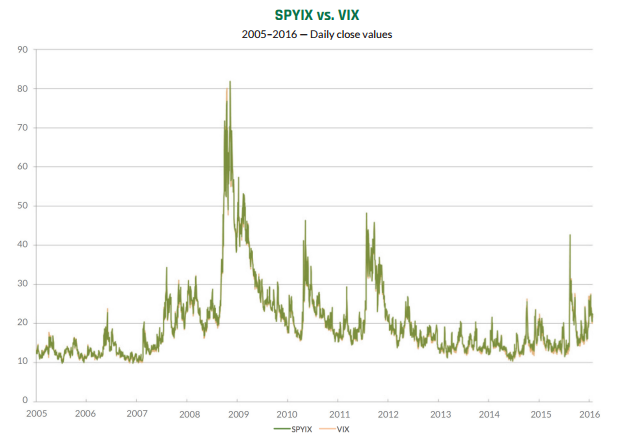
Another thing that I want to point out is a basis "difference". SPY pays quarterly dividend, and that has a small influence on index values. In theory before the ex-date SPYIX and VIX will diverge slightly, and will converge again right after the ex-date. In practice, this effect is not statistically significant (if you're interested in details, email me for exact numbers)
Additional resources:
SPYIX historical values, fact sheet, white paper, sample calculation.
CBOE Takes One Step Toward Exchange-Traded Exotics
 CBOE announced yesterday, that in addition to "vanilla" FLEX options they will offer Asian and Cliquet options to be traded as well. I'm a little rusty on the terminology, so thankfully CBOE provided a handy explanation:
Asian options: An Asian option, also known as an "averaging option," is an option whose settlement value is based on an average of the underlying index closing prices throughout the contract's life, as opposed to the single price at expiration.Cliquet options: A Cliquet option, sometimes referred to as a "ratchet option," is a series of at-the-money forward-start options where the total premium is determined in advance. CBOE is expected to offer a specific type of Cliquet known as the monthly sum cap with a global floor where the option holder receives the greater of zero or the sum of monthly capped returns.
This is obviously another effort from CBOE to capture some part of what now is on OTC derivatives market. With credit lines being what they are after 2008 it would make sense that fraction of exotics trading would end up facilitated by a major exchange and centrally cleared
So far FLEX options have been a good way to be taken for a ride: from the first and second-hand stories I heard, you would pay huge bid-ask spread entering a trade, and there is no liquid market to exit the option, so you either hold to expiration or pay another huge spread to exit.
However I am excited about the development - if we see some volume in these contracts, it is not impossible that some market maker would step forward and request that they will become listed, probably on SPX Index. My bet is on Asian options, as they are more vanilla-like, and (highly non-technical description) trade at effectively lower volatility because of averaging.
Some New Developments In Volatility Calculations
If you're working with daily data (without access to intraday data) and need to calculate volatility, then using close-to-close squared returns is by far not the best way to go. Trades and quants know that it is a very noisy metric, and come up with few work-arounds. In this post I will do a very quick review of some available options, as well as new developments. I am not planning a thorough review or comparison, rather just to offer my personal opinion, based on practical experience of what works better.
Quants tend to like either modelling some long-term average of daily squared returns (which introduced autocorrelation), or using GARCH to filter out smooth volatility process based on the data. GARCH model of daily returns, in my experience, also performed quite poorly, especially in forecasting future volatility.
Traders tend to use ATR - average true range - as a measure of price variability (quick tip: daily volatility ≈ ATR / stock price / 1.6). Another very similar estimate based on squared range, called Parkinson's volatility estimator.
 Better volatility estimates have been devised: Garman-Klass and Rogers-Satchell volatility estimators are much better than others mentioned above. Yang-Zhang estimator has theoretically even higher accuracy, but works only for multi-day estimates. Magdon-Ismail and Atiya published another estimator but (according to their own research) it works only slightly better than R-S and G-K estimators, while being much more complicated from computational point. A quick note about the formulas to the right - similar to Y-Z estimator, G-K and R-S can also be adjusted to include overnight return,
see e.g. this.
Recently there were three interesting developments in estimators based on OHLC data.
Last year Bruno Dupire introduced what he called a Move-based estimator, a volatility estimate that reflect the cost of option hedging. I have to honestly admit, that after reviewing the presentation several times I still don't understand how the estimator is derived. If you can explain it to me, please email or comment below.
Jerzy Pawlowski created a skew-like and moment like estimators based on OHLC data, here slides 6 and 7, with R code available here.
Finally, not quite recent (2008) but also important is this correlation formula from Rogers and Zhou.
Quants tend to like either modelling some long-term average of daily squared returns (which introduced autocorrelation), or using GARCH to filter out smooth volatility process based on the data. GARCH model of daily returns, in my experience, also performed quite poorly, especially in forecasting future volatility.
Traders tend to use ATR - average true range - as a measure of price variability (quick tip: daily volatility ≈ ATR / stock price / 1.6). Another very similar estimate based on squared range, called Parkinson's volatility estimator.
 Better volatility estimates have been devised: Garman-Klass and Rogers-Satchell volatility estimators are much better than others mentioned above. Yang-Zhang estimator has theoretically even higher accuracy, but works only for multi-day estimates. Magdon-Ismail and Atiya published another estimator but (according to their own research) it works only slightly better than R-S and G-K estimators, while being much more complicated from computational point. A quick note about the formulas to the right - similar to Y-Z estimator, G-K and R-S can also be adjusted to include overnight return,
see e.g. this.
Recently there were three interesting developments in estimators based on OHLC data.
Last year Bruno Dupire introduced what he called a Move-based estimator, a volatility estimate that reflect the cost of option hedging. I have to honestly admit, that after reviewing the presentation several times I still don't understand how the estimator is derived. If you can explain it to me, please email or comment below.
Jerzy Pawlowski created a skew-like and moment like estimators based on OHLC data, here slides 6 and 7, with R code available here.
Finally, not quite recent (2008) but also important is this correlation formula from Rogers and Zhou.
Triple Expiration
Next time, for the first time in SPX history, we will have 3 expirations in one week: on Monday Feb 29 month-end options will expire, newly listed Wednesday weeklys will expire on Wednesday Mar 2, and "regular" weeklys on Friday Mar 4. All of the options expire in the PM. And I have positions in all 3.
Speaking of Wednesday weeklys, the launch was a clear success. On the first day of trading - this past Tuesday, quotes width was somewhat sporadic, but the last few days I see that the width is pretty much like a regular weekly expiration, with volume and open interest also at quite respectable levels.
Speaking of Wednesday weeklys, the launch was a clear success. On the first day of trading - this past Tuesday, quotes width was somewhat sporadic, but the last few days I see that the width is pretty much like a regular weekly expiration, with volume and open interest also at quite respectable levels.
Old VIX vs New VIX - Simple Explanation
CBOE started disseminating VIX index in 1993. At that time the index was based on OEX (S&P100) options, that were most liquid index options at the time, and was calculated using weighted average of Black-Scholes implied volatility of ATM options. Ten years later CBOE changed the calculating, moving from OEX to more liquid SPX options, and also, most importantly, completely changing the calculation formula.
This formula for new VIX is not intuitive, and is quite complicated, but I will explain both old VIX formula and new VIX formula in simple geometric terms. Let's create a chart of options prices, calls and puts, vs their strikes. You will end up with a chart that looks something like this -

If options are relatively expensive the lines would be higher; if options are relatively cheaper the the lines would be lower. At one point, these lines will intersect, and the strike where they intersect will be very close to where the underlying index is trading. And the height of the point where these lines intersect is (approximately) proportional to the old VIX value. If volatility is high, then options are expensive, and the height of intersection point will be higher. If volatility is low, the height will be proportionally lower.
The math behind this is based on approximation for the price of ATM straddle ≈ 0.8 * index price * volatility * √ time to expiration In our case, volatility ≈ height of the intersection point (0.4 * index price * √ time to expiration )
New VIX is calculated in a very different way, but also has the place on the chart. Take the area under the call and put curves, that looks like a curved pyramid.

The area under the curve is (approximately) proportional to the square of the new VIX! This is something that I covered in a previous post, so for the sake of not repeating myself I will just summarize:
old VIX is proportional to the height of the pyramid, new VIX is proportional to the square of the area of the pyramid.
This connects two ideas, and also shows how new VIX uses information from all options, as opposed to the original VIX that uses only ATM options.
This formula for new VIX is not intuitive, and is quite complicated, but I will explain both old VIX formula and new VIX formula in simple geometric terms. Let's create a chart of options prices, calls and puts, vs their strikes. You will end up with a chart that looks something like this -
If options are relatively expensive the lines would be higher; if options are relatively cheaper the the lines would be lower. At one point, these lines will intersect, and the strike where they intersect will be very close to where the underlying index is trading. And the height of the point where these lines intersect is (approximately) proportional to the old VIX value. If volatility is high, then options are expensive, and the height of intersection point will be higher. If volatility is low, the height will be proportionally lower.
The math behind this is based on approximation for the price of ATM straddle ≈ 0.8 * index price * volatility * √ time to expiration In our case, volatility ≈ height of the intersection point (0.4 * index price * √ time to expiration )
New VIX is calculated in a very different way, but also has the place on the chart. Take the area under the call and put curves, that looks like a curved pyramid.
The area under the curve is (approximately) proportional to the square of the new VIX! This is something that I covered in a previous post, so for the sake of not repeating myself I will just summarize:
old VIX is proportional to the height of the pyramid, new VIX is proportional to the square of the area of the pyramid.
This connects two ideas, and also shows how new VIX uses information from all options, as opposed to the original VIX that uses only ATM options.
CBOE to List SPX Wednesday-Expiring Weeklys Options
 CBOE announced yesterday that they will start listing SPX weekly options series with the same expiration time as VIX options. While it is not clear from the press-release, the circular clearly states that new options will be PM-settled, adding half-day of basis risk for traders. Overall I think this contract specification is somewhat surprising, but let's go over the history of VIX to understand CBOE's position.
Original VIX, as introduced by CBOE in 1993 was based on OEX (S&P100) options, most liquid index options at the time, and calculated by interpolating Back-Scholes implied volatililities of ATM options; OTM options did not figure in the calculation. VIX was already in use for 10 years, when in 2003 CBOE updated VIX methodology in two ways - first, moving from OEX to SPX, more liquid index options market, and changing the calculation to be in line with a formula for a variance swap - an OTC instrument that allowed for a pure (as in no delta, no rebalancing required) bet on variance.
While not exactly the same (VIX is a square root of var-swap, a non-linear transformation which makes static replication impossible) VIX futures and options became a class of its own. The original foundation of VIX vs basket of 30 day SPX options became less important as VIX complex became the dominant market leading the price discovery in volatility.
However that led to some inconvenience for traders - if you have two correlated markets like SPX and VIX, and you treat them as observable (as opposed to some model based latent quantity) you would want to naturally trade one against the other. However with Wednesday vs Friday expiration this adds significantly to residual risk. But current solution (Wednesday PM) begs a question - why PM? Trading VIX vs SPX Wedensday options still leaves half-day of difference?
I called CBOE (so you don't have to) asking for a comment. After being transferred from one person to another I received an answer that can be summarized as "we cannot comment on product design decisions" . Basically what it means is that CBOE decided to add another day for expirations, and designed the product to be similar to existing weeklys (PM). They were not meant to perfectly align with VIX complex, despite what it says in the press-release.
FWIW I think this is actually an unfortunate decision, and lost opportunity for CBOE.
Subscribe to:
Posts (Atom)
Weekly market report
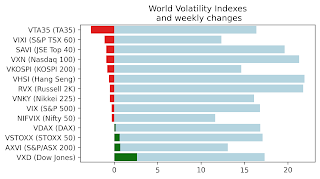
Wall st delivered a mixed bag of news with VIX, VNKY, and VSTOXX and their underlying markets almost unchanged. VXD - volatility index based...
-
 If you're working with daily data (without access to intraday data) and need to calculate volatility, then using close-to-close squared ...
 -
As I am sure all of you know Russia has began a full scale war against my home country Ukraine. Please make no mistake - Putin's goal ...
-
Deutsche Bank Currency Volatility Index was developed to provide an implied volatility benchmark for major currency markets. The index is d...