When I'm wrong, I must admit that I'm wrong. Some time ago I published a post pointing out potential vulnerability of VIX settlement price to manipulation. As was recently pointed by a reader (and I contacted CBOE to confirm the details) I was incorrect in my understanding of settlement calculation of VIX index.
The reader pointed out that "bidding 0.05 for a 1 lot makes the option very unlikely to be included in the strip. Indeed, if you have a significant size of seller at 0.05, your bid will be hit and filled while no other bid would be left behind which would make the option a "0 bid" option, hence non included in the official strip.
You would be left like many traders before you wondering how they got filled on their bid thru the official rotation while this strike isn't included in the official strip."
CBOE documents state that the settlement price is calculated from all opening trades, and opening quotes for strikes where trades were not available. My initial understanding was that that zero bid filter applied only to regular everyday VIX calculation that is calculated from quotes, but not to settlement calculation that is based on trades. However the correct understanding that zero bid filter applies to settlement calculation as well. So e.g. in the case of some really low put strike, if you submit a nickel bid at the pre-open, it will get filled, but if the resulting opening quote has zero bid that strike will be ignored in the VIX settlement calculation.
My sincere apologies to all the readers, and thanks to WB for pointing out the error.

Nations VolDex (VOLI)
Nations VolDex is an alternative market volatility index. As everyone knows VIX product suite is a huge success and a big revenue generator for CBOE, which holds exclusive rights to the product. ISE has teamed up with Chicago-based NationsShares to launch VIX-like product and hopefully bring over some of that revenue to ISE.
How is VolDex different? VolDex is calculated from ATM options on SPY, while VIX is calculated from all options on SPX. Exact algorithm for VolDex is currently not disclosed (yes, I emailed and called the company). The basic overview can be found in SEC filing from ISE, but the document does not describe eactly how they calculate IV.

As one can plainly see the two indexes are not very different, the levels are quite correlated. VIX tends to run higher than VolDex.

The ratio (VIX/VolDex) is pretty much constant through the time, with average of 1.094 and median of 1.096, showing no significant skew.


The ratio does not appear to be related to the level, but difference (VIX-VolDex) shows linear relation to the VIX level. This (admittedly very simple) analysis leads me to suggest the simplest possible model: VolDex = 0.92 * VIX + noise. Of course, a more complicated model would be advised for trading, but this basic model has in-sample R^2 of 0.99.
Before I present my own analysis here are two articles from Risk, first introducing the VolDex, and second from CBOE providing a response on technical points, as well as CBOE's comment letter to SEC.
Vix challenged by new volatility index, by Yakob Peterseil (try this link, or this)
CBOE responds on Vix, by John Hiatt (link)
CBOE's comment letter to SEC (link)
In the Risk article Scott Nations is quoted saying "Because the spot Vix is impossible for traders to replicate, it becomes impossible for arbitrageurs to keep the levels of Vix futures consistent with the spot level of the Vix" I don't see that as valid argument, as I don't see how one can statically replicate VolDex futures. (Dynamic replication is possible, and I suspect it will be a practical nightmare)
CBOE argues (in the SEC comment) that VolDex is not a broad-based index, and can be easily manipulated. They provide an example that on the futures expiration day index will be calculated using only two front month SPY, and depending on where the spot is to the strike, most of the index value can come from a single option. I believe that the argument is theoretically valid, but I am having a difficulty figuring out how much the index could be manipulated in such way. If you have any thoughts on how to quantify this effect, send me an email.
On the other hand it is possible that the index would be more robust to manipulation: it does not use far otm puts that have disproportionate weight in the VIX. I wrote about this earlier in How to manipulate VIX settlement price. ATM options are most deep and liquid of any series, so manipulating them would be very expensive.
Overall, I think that both CBOE and ISE/Nations know that the indexes are not that much different from each other, and the arguments presented are of limited practical relevance. ISE also know that if they were to launch some volatility index that is really really different than VIX it will likely fail to attract any liquidity. I think the goal here is that VolDex will be similar enough to VIX that cross-hedging is possible, plus ISE will likely to provide substantial discounts on fees for the new product to attract market-makers.
At the time of writing VolDex options are pending SEC approval, and there is no mention of VolDex futures at all.
How is VolDex different? VolDex is calculated from ATM options on SPY, while VIX is calculated from all options on SPX. Exact algorithm for VolDex is currently not disclosed (yes, I emailed and called the company). The basic overview can be found in SEC filing from ISE, but the document does not describe eactly how they calculate IV.
As one can plainly see the two indexes are not very different, the levels are quite correlated. VIX tends to run higher than VolDex.
The ratio (VIX/VolDex) is pretty much constant through the time, with average of 1.094 and median of 1.096, showing no significant skew.
Before I present my own analysis here are two articles from Risk, first introducing the VolDex, and second from CBOE providing a response on technical points, as well as CBOE's comment letter to SEC.
Vix challenged by new volatility index, by Yakob Peterseil (try this link, or this)
CBOE responds on Vix, by John Hiatt (link)
CBOE's comment letter to SEC (link)
In the Risk article Scott Nations is quoted saying "Because the spot Vix is impossible for traders to replicate, it becomes impossible for arbitrageurs to keep the levels of Vix futures consistent with the spot level of the Vix" I don't see that as valid argument, as I don't see how one can statically replicate VolDex futures. (Dynamic replication is possible, and I suspect it will be a practical nightmare)
CBOE argues (in the SEC comment) that VolDex is not a broad-based index, and can be easily manipulated. They provide an example that on the futures expiration day index will be calculated using only two front month SPY, and depending on where the spot is to the strike, most of the index value can come from a single option. I believe that the argument is theoretically valid, but I am having a difficulty figuring out how much the index could be manipulated in such way. If you have any thoughts on how to quantify this effect, send me an email.
On the other hand it is possible that the index would be more robust to manipulation: it does not use far otm puts that have disproportionate weight in the VIX. I wrote about this earlier in How to manipulate VIX settlement price. ATM options are most deep and liquid of any series, so manipulating them would be very expensive.
Overall, I think that both CBOE and ISE/Nations know that the indexes are not that much different from each other, and the arguments presented are of limited practical relevance. ISE also know that if they were to launch some volatility index that is really really different than VIX it will likely fail to attract any liquidity. I think the goal here is that VolDex will be similar enough to VIX that cross-hedging is possible, plus ISE will likely to provide substantial discounts on fees for the new product to attract market-makers.
At the time of writing VolDex options are pending SEC approval, and there is no mention of VolDex futures at all.
F# In Finance & Big Data In Finance

Two excellent events Andrew Sheppard of Fountainhead (and HPC & GPU Supercomputing Meetup)
F# in Finance (London)
If you are a functional programmer (even in a language other than F#, such as Haskell, Scala, Clojure, Ocaml, Erlang); or a quant, trader, risk officer, Big Data programmer, Data Scientist, software development manager, or anyone who wants to get more done -- and done better -- with less code:
- Come and see how F# is being used in finance for Machine Learning, Parallel Programming, Big Data and the Cloud. Plenty of lessons at this event for programmers in other functional languages.
- The event is also hosting a recruitment fair for functional programmers. Whether you are looking for functional programming talent, or looking to break into functional programming as a career move, this event is the place to be.
- Meet Don Syme, inventor of F#!
The second event is Big Data In Finance MOOC. There are two tracks - no cost open access, and a paid professional access which provides deeper learning experience and also a certificate from Baruch college. Several practical projects are covered: CVA (credit valuation adjustment) which Dr Sheppard has extensive experience, Data Mining & Machine Learning using Hadoop, and Building a Look-Ahead (Predictive) Ticker Plant.
ASX To Expand The Range of Volatility Products

This is certainly a smart move - at this point liquidity in Asian volatility products is low. The plan is that launching a "packaged" retail-friendly ETF product will attract interest from wider group of traders.
Original link.
ASX VIX Futures Launched
I am having a hard time accessing data for the contract. On Bloomberg, the index is SPAVIX <INDEX> , but the ticker for the futures is AS51VIX <INDEX> . I tried checking the prices just few minutes ago, but there was no data for any of the futures contracts, as if they don't exist. Edit: the current contract is VIA <INDEX> .
Exchange's own website is not much of a help either - futures summary table does not have the data for the VIX contract (futures root VI). I was able to figure out this non-linked page with the data:
| Expiry | Last | Bid | Ask | Volume |
|---|---|---|---|---|
| Spot | 12.295 | |||
| Nov 13 | 12.45 | 13.10 | 0 | |
| Dec 13 | 12.00 | 11.90 | 12.10 | 1 |
The volume in other international volatility contracts on Tuesday was:
RTSVX (Russian volatility index) - 2 contracts
VHSI (Hong-Kong volatility index) - 19 contracts
VNKY (Nikkei volatility index) - 71 contracts
Two pretty good articles on HFT
These articles Jacob Loveless were posted few months ago on ACM (Association for Computing Machinery) blog, but I just came across them.
Barbarians at the Gateways includes details on specific HTF trading strategy
Online Algorithms in High-frequency Trading provides high-level overview of some mathematics that is used for data analysis
Barbarians at the Gateways includes details on specific HTF trading strategy
Online Algorithms in High-frequency Trading provides high-level overview of some mathematics that is used for data analysis

Subscribe to:
Posts (Atom)
Weekly market report
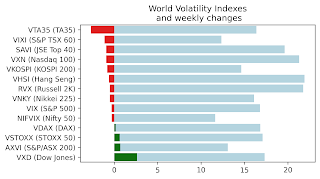
Wall st delivered a mixed bag of news with VIX, VNKY, and VSTOXX and their underlying markets almost unchanged. VXD - volatility index based...
-
 If you're working with daily data (without access to intraday data) and need to calculate volatility, then using close-to-close squared ...
-
As I am sure all of you know Russia has began a full scale war against my home country Ukraine. Please make no mistake - Putin's goal ...
-
VIX expiration day often coincides with particularly heavy trading activity in underlying SPX options. VIX settlement value, or VRO rarely m...
