Frontiers in Time Series and Financial Econometrics

While I try to focus on original content on this blog, this paper is an excellent overview of latest developments in financial time series.

Abstract:
Two of the fastest growing frontiers in econometrics and quantitative finance are time series and financial econometrics. Significant theoretical contributions to financial econometrics have been made by experts in statistics, econometrics, mathematics, and time series analysis. The purpose of this special issue of the journal on “Frontiers in Time Series and Financial Econometrics” is to highlight several areas of research by leading academics in which novel methods have contributed significantly to time series and financial econometrics, including forecasting co-volatilities via factor models with asymmetry and long memory in realized covariance, prediction of Lévy-driven CARMA processes, functional index coefficient models with variable selection, LASSO estimation of threshold autoregressive models, high dimensional stochastic regression with latent factors, endogeneity and nonlinearity, sign-based portmanteau test for ARCH-type models with heavy-tailed innovations, toward optimal model averaging in regression models with time series errors, high dimensional dynamic stochastic copula models, a misspecification test for multiplicative error models of non-negative time series processes, sample quantile analysis for long-memory stochastic volatility models, testing for independence between functional time series, statistical inference for panel dynamic simultaneous equations models, specification tests of calibrated option pricing models, asymptotic inference in multiple-threshold double autoregressive models, a new hyperbolic GARCH model, intraday value-at-risk: an asymmetric autoregressive conditional duration approach, refinements in maximum likelihood inference on spatial autocorrelation in panel data, statistical inference of conditional quantiles in nonlinear time series models, quasi-likelihood estimation of a threshold diffusion process, threshold models in time series analysis - some reflections, and generalized ARMA models with martingale difference errors.

Quick Note on MLKJ Day

While president Reagan signed the holiday into law in 1983, NYSE did not make it a full-day exchange holiday until 1998. Source.

If you are as anal meticulous as me about having proper implied volatility numbers, time to expiration (that is normal expected time to expiration) these things matter. The last time I checked popular financial library quantlib their US calendar implementation, it had MLKJ day as holiday every year, even before 1998.


Volatility Conversion

Re:Simple Trick to Convert Volatility
Reader asks, "I have weekly volatilities over 370 weeks, I like to convert this into an annualized volatility. How does this work?"
Since volatility is weekly, in the linear case the multiplier would be 52 (weeks per year) , so for volatility you should multiply your weekly volatility by √ 52.
In fact, the length of the measurement - 370 weeks - does not matter at all. If you would have 3 weeks or 7 weeks of weekly volatilities, multiplier would be the same. It is the frequency of observation that matters. To illustrate this consider another example: you have daily volatility over 370 weeks. To annulalize, multiply your daily volatility by √ 252 where 252 is the usual number of trading days per year in the US.

Another Vol Arb Mutual Fund

Recent press release from Franklin K2 Alternative Strategies Fund (Canada) shows that one of the sub-managers trades volatility arbitrage strategies. There are four "candidates" and googling suggests that Basso Capital Management is the manager running volatility strategy. Performance of the fund has been lackluster, and management fees are quite high.

Dr John Nash Dies in Crash

Dr John Nash, who made pivotal contributions to game theory and differential equations was killed on Saturday in an automobile accident with his wife Alicia. He received a Nobel Prize in economics for his work in the theory of non-cooperative games. Nash equilibrium has been applied to modelling company merges and takeovers, portfolio optimization, and algorithmic trading.

Bloomberg article.

VIX Weeklys

VXST options looked like a great product on paper - cheap, short term options, massive mean-reversion, huge gamma -  however trading just did not take off. Now CBOE is trying different angle - similar to regular weeklys, the exchange is launching weekly VIX futures, and weekly VIX options. To clarify - these are not weekly options on VXST, they are not weekly futures options (like CBOE proposed some while ago). These are options on the VIX index, just with more frequent expirations.

Officail product page. Hat tip to Nakul Nayyar.


Alternatives To Matlab

Reader Eli asked in the comments "I used to program in Matlab a lot in the past. Now I feel that Python is a better way to go. Any thoughts?

Yes, quite a few - however I also hope to hear some ideas from other readers. Matlab is an excellent tool for analytics, and I have been using it for over a decade now. However if I were starting out in quantitative finance today I would probably go with Python. The main reason: Python is more popular - and bigger community means more ideas being exchanged, and potentially more job prospects. I get calls from recruiters telling me that quite a few banks have switched to Python as their main analytics tool.

However I am not ditching Matlab just yet. In my experience, Python is still much slower, more bloated, not as well documented as Matlab. Matlab is the Ferrari, where Python is basic Ford. The firm were I work pays for the license, for which I am immensely grateful!

The real question is, what's next? Matlab is not cheap, and it is important to stay on top of the latest tools. I suspect that Python will continue growing in popularity over Matlab.

But I think there are more interesting tools in development:

1 - Julia 
2 - F# programming language. In particular I have been experimenting with FCore linear algebra library as stand-in for Matlab. Not all Matlab features are implemented, but basic support for logical indexing exists, and I was able to add simple custom functions to fill in whatever functionality I needed. Regression tools seem better that other .net linear algebra packages. I hope to write more about this in the future posts.

What tools are you using? Please share in the comments!

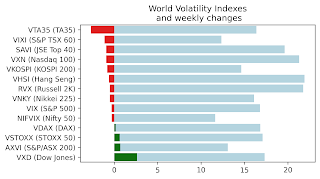
Weekly market report

Wall st delivered a mixed bag of news with VIX, VNKY, and VSTOXX and their underlying markets almost unchanged. VXD - volatility index based...