Maximum Pain Theory

I think if you're reading this blog, you're probably already a knowledgeable options trader, and have heard of maximum pain theory - an idea that market moves in a path that hurts ( causes losses ) most amount of market participants. In options it is typically stated that simulating options expiration losses by open interest at different strikes will help you to divine its expiration value. The idea is closely related to options expiration pinning - another idea that hedging pressure causes options to drift toward strikes with highest open interest.

All ideas above have been researched, and found some academic support - this paper by Avellaneda and Lipkin is an update of their seminal 2003 paper, another on pinning that contrasted optionable with non-optionable stocks, or this theoretical research into market feedbacks. However the empirical consensus is that on any particular stock this effect is rather small, and signal is too weak to be a stand-alone strategy.

I have been following options market on Deribit already for some time. Because options expire into an index, calculated from BTC/USD rate of 5 other exchanges, the hedging feedback mechanism would have a lot of friction, and probably does not exist. However, open interest could reflect market information in another way.

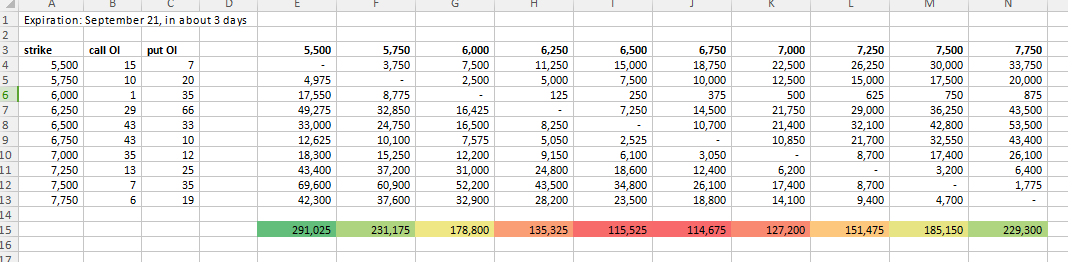
Here is a small spreadsheet where I calculated max pain strike for front (21st) and second (28th) expirations. Front is weekly, while second has been listed for 5 months now and has a much larger set of strikes. I trimmed the simulations in the second expiration but it does not effect the calculations.


Google sheet

The max pain strike for the front is 6750, followed closely by 6500, about 250 above where the market is now. For the second expiration, max pain strike is at 7000, followed by 6500. These ranges - 6500-6750 and 6500-7000 appear reasonable given recent market movement, but I would not read too much into them. We'll wait and see what the market actually does.  

Jonathan Kinlay on Volatility Modelling

Few weeks ago Dr Jonathan Kinlay from Quantitative Research and Trading blog published a series of excellent articles on volatility. I wanted to review and comment on the notes.

Forecasting Volatility in the S&P500 Index
Modeling Asset Volatility
Long Memory and Regime Shifts in Asset Volatility
Range-Based EGARCH Option Pricing Models

There are four main articles that discuss practical volatility forecasting topics. The material is not new; it was published around fifteen years ago by Dr Kinlay's previous funds, Caissa Capital, Investment Analytics, and later Proteom Capital.

As I understand Kinlay was the idea generator behind volatility trading, and Proteom Capital had some excellent years in 2003 and 2004, and that was pretty much it. Managers typically don't close funds because of great performance, but I don't know what actually happened; if you have any information, please send me an email.

Regardless, the published research is important, and I believe worthwhile to pay attention to. I will also comment on some more recent updates.

Forecasting Volatility in the S&P500 Index
tl;dr : Arfima-Garch, straddles trading.
my comment: While we know that autocorrelation of volatility decays very slowly, Arfima-Garch is actually pretty bad at predicting volatility. Midas and HAR(X) type models using realized volatility (and jumps, or other factors) have been demonstrated to be perform much better. The weakness of Garch seems to come from both the form and MLE estimation 'issues' but that's a separate topic.

Modeling Asset Volatility
tl;dr : volatility exhibits complex dynamics - long memory, momentum, and mean reversion
my comment: The most interesting part is the last paragraph - "Dispersion"  This is not dispersion in the index vs names sense, at least not exactly. The idea (if I understand correctly) that both first and second moment relationships can be used to construct cointegrated baskets of options. Not sure how it is supposed to work in practice - do you hedge gammas or not?

Long Memory and Regime Shifts in Asset Volatility
tl;dr : remember all that stuff about long memory? actually, it could be structural breaks, and no long memory
my comment: structural breaks can confound models, luckily there are break test available. This is an import point, don't skip this one.

Range-Based EGARCH Option Pricing Models
tl;dr :2 factor Egarch, but on ranges instead of squared returns.
my comment: 20 years ago having ability to store and process tick data was uncommon, and calculating realized volatility was not possible. Therefore models were developed based on 'newspaper data' - daily open, high, low, close. Range Egarch has several features that make it better than let's say garch - 
1, range being far better vol estimator than squared returns,
2 - log vol is much better behaved, and makes estimation more robust,
3 - two components in the model, fast and slow vol. 
Range Egarch was probably one of the best way to create decent vol models back then, but of course better methods exists today. Now all production models feature these three elements ( robust estimate of vol, power transformation / generalized error, multiple scales ) in one way or another.
Good-bye MANA Partners

MANA Partners, a much-hyped trading firm founded by Manoj Narang (ex-Tradeworx) is in a total tailspin after launching trading in January 2017.

According to a confidential source, the firm had as much as 400M AUM, however its trading record was anything but dismal, losing money almost every month since inception. Most investors withdrew money immediately after 1-year lockup period, and now the firm has less than tenth of AUM they started with. The staff count has been decimated as well.

In addition I was told that the firm has spent prodigally on top quality feeds, colo, hardware, and other infrastructure, but that IP belongs not to the hedge fund, but rather to the technology affiliate MANA Tech llc.

As recently as April, Institutional Investor profiled Mr Narang in most glowing terms, ranking him #1 in their Trading Technology 40 list.

What's The Opposite Of "To The Moon" ?

As BTCUSD rate is falling ( down to the Earth? ) prudent traders know that there are many ways to play the market. Of course people who were short futures, or long puts are able to realize gains, but I would like to suggest other ways to play the market as well.

1 - There is a limited downside to the market, and steep call skew. If you think that market will recover, you can purchase at calls, financing them with 2 otm calls. For example, end of August 6500 / 7500 spread, for a small debit.

2 - If you think the market is going lower, consider buying near put, financed by otm call. 5000 / 8000 end of August spread looks reasonable, and at this futures level quite closer to the down strike.

My preferred way to spread the market is by not by vertical spreads, but rather with calendar and diagonal spreads. I will be discussing these strategies in the future, but in the meantime wanted to share some news: it seems like after recent Bitmex outage, Deribit has been gaining new futures traders. While I typically don't write about this - besides options, Deribit is a solid and stable futures platform.

Bitcoin Volatility, Skew, and Options Pricing, Part 3

Recently Deribit, the leading cryptocurrency options exchange introduced a new service - crypto-based USD loans. Here is a blog post that describes existing marketplace for crypto-based loans, and the loan service that they are offering. The service is radically different from existing services, as it relies on hedging.

As described in that blog post I linked above, existing services rely on getting a collateral much higher than the value of the loan, to compensate for the high risk of volatility of crypto. For example, lender may require a 50% loan to value ratio, lending 0.50 per 1.00 of crypto collateral. This is obviously not very efficient use of capital, and still does not protect the lender if value of collateral falls below 50%.

Deribit will be using a combination of over-collateralized lending as above and hedging to provide better rates. For example they may offer 75% loan to value ratio, lending 0.75 for 1.00 of crypto collateral, but hedge their remaining risk by purchasing puts. If the value of collateral declines, the combination of reserve and long put option will protect them from loss.

Why is this important? The answer, in one word would be - SKEW. Crypto lending is a growing market with demand exceeding the supply. If Deribit's lending service will take off, it will create a strong, systematic buying pressure on puts, raising the left skew. I wrote before that markets treat BTC as a speculative asset, with call skew. In a year from now we may see a more symmetric skew behavior in BTC.

Such change may provide an opportunity for an interesting trade - to substitute BTC deltas with a long near ATM call and short OTM put, to capitalize on skew differential.

Bitcoin Volatility, Skew, and Options Pricing, Part 2

The market for BTCUSD options is not a recent phenomenon. There were several "startup" exchanges offering options since shortly after Bitcoin itself rose in popularity. Most them failed in contract design, particularly in their design of handling margining of short option positions, or failing to design decent interface to attract traders, or getting active market makers to provide liquidity. To digress, in my experience most of the cryptocurrency exchanges appear to be designed and operated by web-developers, with no knowledge of how modern financial exchanges work.

Anyway, there is one leading exchange for trading cryptocurrency options - Deribit , and several runner-ups. LedgerX is CFTC registered exchange based in the USA, unfortunately liquidity is at this time is quite low. Their contracts are large, aimed at institutional traders, and trading is somewhat sporadic. Bitmex, a leading futures exchange recently introduced a very poorly designed options contract; liquidity is non-existent. Quedex is another options-focused platform, but I cannot find any volume figures or statistics.

As I mentioned above, only Deribit offers robust liquidity at this time; in the next blog post I will explore bitcoin options pricing and trading strategies.

Bitcoin Volatility, Skew, and Options Pricing

As I wrote before, Bitcoin volatility is quite different from volatility of other assets. I will continue with the same topic here.

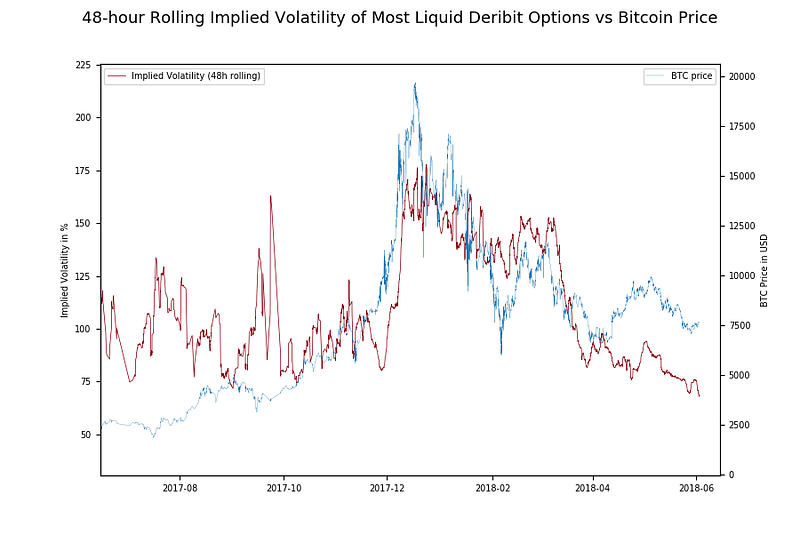
Bitcoin prices shot up to all-time highs this winter, and have sharply declined since. When an equity index declines, volatility typically moves up, but in the case of BTC, volatility has actually declined. This behavior is similar to VIX index. Although I know that mechanism behind this effect is completely different, I want to quote Brian Stutland from about a month ago who said

"Bitcoin is sort of becoming the new VIX, in sort of getting ahead of credit risk in the banking industry,"
"There is huge correlation right now between VIX and bitcoin 30 days ago, 30 trading days ago, that is starting to measure out credit risk in the market. That's what cryptocurrency is becoming. It's becoming a way to sort of de-risk yourself from credit risk in the banking industry."

I think that Mr Stutland's analysis is correct, but only explains a part of BTC movement, as other intrinsic speculative factors certainly dominate.


I calculated median monthly price, and volatility (high accuracy from intraday data), and the correlation indeed looks reasonable on raw prices, but not as well on log scale.


While this analysis is done using realized volatility, blogger Flood did similar analysis using implied volatility derived from options prices on Deribit.


Having established the effect, I believe there is a simpler explanation for positive BTC skew - traders as aggregate think of BTC as a speculative, gambling asset as opposed to investment. When prices are high, and speculators are excited, volatility moves up as well. Now that prices have declined, and speculation frenzy subsided, volatility fell as well.

This is great news for long term investors in BTC, who can purchase either cheap puts as hedge for existing holdings, or cheap calls as speculation.

In the next article I will write about pricing of BTC options, and Deribit exchange.

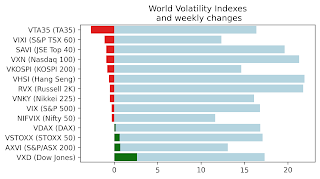
Weekly market report

Wall st delivered a mixed bag of news with VIX, VNKY, and VSTOXX and their underlying markets almost unchanged. VXD - volatility index based...