Correct Theta for VIX options, Part 2

Using calculus we calculate total change of option price as composed of regular Black-Scholes Theta, and also Vega * change of volatility per unit of time.

dC/dT = ∂C/∂T + ∂C/∂σ ∂σ/∂T

Theta and Vega are known model parameters, while the ∂σ/∂T can be modeled either from time series of VIX, or fitting a model to a set of VIX derivatives, or fitting some function to the term structure of (ATM) volatility.

One should note that the first and second term have opposite signs. Theta is negative, Vega is positive, and since volatility increases as we get closer to expiration ∂σ/∂T is also positive. Practically this means that cēterīs paribus options will stay relatively juicy comparing to similar equity options.

Week in Volatility


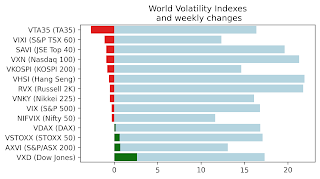
Markets fell, S&P was down almost 4% for the week, and volatility indexes are up - on average by 4 points. VIX is up 4.58 points, from 23.95 to 28.53. Futures are up in an almost parallel shift from a week ago. The rise in volatility did not create enough pressure on the market for contango. Feb 2011 futures started trading, settling at almost 31.

Modeling VIX for trading

There is a research paper on SSRN that discusses modeling VIX in a manner similar to the one I described last week. In particular they use Box-Cox transform to "normalize" VIX time series. The authors claim that optimal B-C parameter lambda is -0.4, much different from normal (1) or log-normal (0) value. However, being a devil's advocate I tried comparing forecasting results for (0) vs (-0.4) and did not find one parameter being clearly better than the other.

At this point I have not tried other suggestions from the paper, however I did find some ways to make the model more robust.

Correct Theta for VIX options, Part 1

There's been many discussions on the internet regarding the way different software platforms calculate hedge ratios, or Greeks for VIX options. The main problem is in the underlying. Because VIX is not tradable, the underlying for VIX options is the VIX futures contract of the same month. If your software platform calculates delta and gamma using VIX index as the underlying, your greeks will be significantly off.

If futures are not available, one can calculate a synthetic future. For example on can take future to be equal deep ITM call price + strike. Today front month 10-strike call closed at 18.20-18.60. Taking mid-mark 18.40 + 10 = 28.40, which is exactly where futures closed. Another approach - probably more general is to calculate future value from least squares regression on risk-reversals. I believe that approach is used by LiveVol.

However while using the correct underlying (future or synthetic) will give you correct value for delta and gamma, theta (time decay) will not be correct. I am not aware of any commercial platform that calculates VIX theta correctly!

Why is theta different? Because of the term structure of VIX volatility. Since VIX prices are mean-reverting, its volatility is a curve that increases as option gets closer to expiration. That means that every day as option moves closer to expiration, it also gains some portion of Vega proportional to increase in implied volatility.

Volatility declines


Markets are up second week in a row and volatility indexes have declined all around the world. The only exception is GVZ-Gold volatility which slightly up. VIX future are lower across the term structure, long-term futures declining at 29 level.

VSTOXX vs VIX


I could only find VSTOXX time series for the last 7 months; anyone knows where I can get longer history? There are also some "holes" in the chart, due to different holidays in Europe and the US.

Weekly market report

Wall st delivered a mixed bag of news with VIX, VNKY, and VSTOXX and their underlying markets almost unchanged. VXD - volatility index based...