Updated: Blockchain Real-World Applications in Finance

My friend is organizing an event (demo/discussion) on smart contracts. The event is open to U of Chicago MBAs, and readers of this blog. If you're in NYC area, please stop by and say hello in person.

Smart contracts and blockchain technology are transforming capital markets and introducing new opportunities for efficiency and contract design. Join us as we explore this rapidly developing area within the FinTech space. The event will detail a live smart contract example – presented by Ron Papanek – Managing Director of blockchain pioneer Symbiont. Following the demonstration, Emmanuel Aidoo (Director Credit Suisse) and Joe Salerno (CEO Synaps) will discuss current block chain projects that will impact the future of finance.

What Matters for Bitcoin

The other week SEC rejected bitcoin ETF application, causing a sharp decline in bitcoin exchange rate. However after a few days market quickly recovered to pre-decision levels, near all-time bitcoin highs. I offer you some reasons why this is not surprising to me.

Of course if ETF were to be launched that would add significant allocation to bitcoin, and raise the prices. However even at this point in time there are plenty of convenient, completely legal and legitimate ways to purchase bitcoins. ETF would only add a convenience factor, however with a cost of trusting third parties - which would not be the case if you were to buy and store bitcoins directly.

Second, a number of financial instruments tied to bitcoin already exists (see this article for a comprehensive list) and if one is adventurous enough to allocate to bitcoin, one if probably ok with doing it outside of conventional US-ETF framework.

However what set bitcoin prices lower over the last weekend was a dispute of sorts about future of bitcoin - the bitcoin core vs bitcoin unlimited. I am not a specialist, but will try to explain it to the best of my understanding. Imagine you have a software upgrade that is not compatible with the previous version - that is pretty much the issue. The switch is called "hard fork" - hard meaning not compatible. The split in version is somewhat like a split in a political party - it is subadditive: two best scenarios for the value of bitcoin are if everyone stays with core, or if everyone switches to unlimited. The worst scenario is 50/50 split, where two separate incompatible ledgers coexist. I find this nonlinear behavior to be very interesting.

At this point about 11% of nodes have switched to unlimited according to coin dance. I will be writing more about this as the situation progresses.

End of an Era

Interactive Brokers Group, owner of Timber Hill, announced that they will be phasing out their options market operations (link). This is a really a pivotal announcement, that one of the oldest and most established derivatives market making operators is calling it quits. Other options market makers are not doing great either - earlier KCG announced that they are 'shuttering' their options market making business, and from what I hear other firms PL (DB, MS, Citadel) have been stagnant in the last 4-5 years.

IB mentioned that they are not exiting proprietary trading completely " The Company intends to continue conducting certain trading activities in stocks and related instruments." but I really don't understand what exactly are they going to do. Is there a special dividend in the near future for IBKR? Another part of the announcement is re-balancing of GLOBAL with almost doubling of USD share. Is this a good move to be purchasing dollars at multi-year highs? Only time will tell ...

KCG will also continue options trading, although not market making, and I have not hears of any other players exiting the field.

What does it mean for the market? Will spreads widen, or skews become more volatile? Will other market makers step in and profit from the gap? Or maybe there was really no gap - maybe Timber Hill will disappear with a whimper? If you have any predictions please share them in the comments!

Quick Analysis of Market-Implied Election Day Volatility

This is a quick note on market vol implied by SPX options for this year’s U.S. presidential election on Nov 8. Calculating implied event vol, for example for stock options over quarterly earnings announcement day, is commonplace and trivial, but in this election, for the very first time we have an opportunity to analyze the event with unprecedented granularity.

Before 2016, options expirations were available just once per week, typically on Fridays. This year CBOE launched SPX options expiring on Mondays and Wednesdays, allowing us to calculate implied volatility over the 48 hours from the close of Monday, Nov 7 to close on Wednesday, Nov 9. Since voting will take place on Tuesday, Nov 8, the results will probably be tallied to statistical certainty by the close of trading on Wednesday, barring the like of 2000 election debacle.
Looking at options data I calculated table below.

ContractFromUntil (Expiration)Implied Move
SPX.XO10/31/201611/2/20161.20%
SPX.XO11/2/201611/4/20161.16%
SPX.XO11/4/201611/7/20160.85%
SPX.XO11/7/201611/9/20162.17%
SPX.XO11/9/201611/11/20161.22%
SPX.XO11/11/201611/14/20160.79%
SPX.XO11/14/201611/16/20161.08%
SPXPM.XO11/16/201611/18/20161.10%
SPX.XO11/18/201611/21/20160.72%
SPX.XO11/21/201611/23/20160.93%
SPX.XO11/23/201611/25/20160.45%
SPX.XO11/25/201611/28/20161.09%
SPX.XO11/28/201611/30/20161.12%

As expected, the 48-hour period over election day shows the highest implied forward vol of 2.17%, about twice what we would expect for non-election trading period. Alternatively, we can say that market expects about 1.31% election event vol, and “regular” volatility of 0.79% per day. I realize that it is annualized vol of just 12.72%, which is much smaller than VXST but my number is the average through the end of November and by construction excludes election vol .

Also, today (at the time of writing) markets are higher, and vol indexes are higher - this is not surprise as VIX will rise into the election simply on "closer jump" effect.

SAR Volatility Arbitrage Is Having A Great Year

Numbers for September are in and SAR Volatility Arbitrage fund (from Zurich-based Systematic Absolute Return AG) is having a fantastic +8.13% return for September, bringing their YTD return to +36.34%. Firm's website describes the strategy as follows.
SAR Volatility Strategies (“VOLS”) are SAR’s newly developed, model-based and fully automated short-term systems, trading S&P 500 Index volatility. SAR VOLS combines long and short volatility momentum and volatility arbitrage strategies within balanced portfolios to provide protection against volatility spikes and market sell-offs, plus steady returns. 
Somewhat slim on details, I assume they trade mostly VIX futures or VXX. Congratulations, guys!

VXX contango vs Theta decay

Reader Mike sent me a question:
We know that the underlying value of VXX decreases daily, mainly by contango. Also, Put options written against the VXX decrease in value each day by theta decay. However, Put options rise in price when their underlying asset decreases in value. Thus, if volatility were held constant, would the contango of the VXX (which decreases the VXX value, thus increases a written put option value) override the theta decay incurred by that same written put option.

I ask this question in an attempt to determine if writing out of the money Puts against the VXX several months from expiration is a losing proposition given volatility is a constant.
My answer:
Excellent question! Unfortunately, most interesting questions do not have a straightforward answer, so I will try to give you two perspectives on this. First perspective is from the theory, on how financial assets behave, and what we can expect in a market without frictions. Then I will try to show what we know empirically. Human language, at least casual conversation, sometime is very imprecise in description of probabilistic concepts. That is why you read statements like "VXX goes down" or "leveraged ETFs go down" or "long options lose money". This stems either from not understanding or not expressing properly all properties of expected future outcomes. 
Financial assets are usually bounded at zero and positively skewed (like on the chart above) and typical, most common, median outcome is lower than the expected, average, mean outcome. For leveraged ETFs I explained it on my blog, but even better here For VIX futures, or VXX things work the same way - most likely scenario is that your long position will decline in value, but every once in  a while the index will spike up and your position will produce a much larger gain. On average in an efficient market you will be breaking even, as a result of frequent small losses and few large wins. Same for buying options - few large wins, many small losses, beak-even on average; expected P/L = 0.  
Contango in VXX does not make you money if you short VXX, it is just a property of the distribution. Selling options does not make you money, it is just the most likely scenario. I am not saying that there are no strategies that you could pursue to identify if an option (or any other financial instrument) is over or underpriced, and try to profit from some strategy, it is that just any particular act by itself, such as "short VXX" or "short option" or "long stocks" or any other "strategy" like  "buy|short [financial instrument]" will on average only break even. Such strategy may however be positively skewed, or negatively skewed. So in theory, writing VXX puts is expected to break even - unless you have some strategy to identify overpriced VXX puts and sell those, but you did not specify an such method in your email. It is that just intrinsically (just by virtue of their existence) these puts (or any other puts) are not overpriced - some very smart people are on the other side of your trade, and they dislike losing money as much as you do.
Now, to the practical part -  when we talk about writing puts on VXX you have two factors opposing each other - VXX most likely to decline in price, bringing you put farther into the money, and short put is most likely to decline in value as well. Let me add few more factors - increase in VXX volatility is more likely to be correlated with
increase in VXX level, so will work in favor of your put sale. On the other hand VXX indeed declines (slightly) on average due to trading frictions,  commissions,  ETF fees, etc. So to understand the NET effect of these disparate factors you will have to crunch some data. When I get around to doing that, I will write something on my blog.

9/11 Bill Veto and Market Volatility

I just left a panel discussion event organized by Sigma Analysis and Management and wanted to share one thing with the readers. The star of the panel was Nancy Davis of Quadratic Capital, a veteran volatility manager. She was head above other panelists on volatility trading, and provided no fluff technical answers - a rare thing for discussion panels.

When asked on upcoming events Ms Davis suggested the following potential catalyst: recently passed hot-button issue of 9/11 bill that strips sovereign immunity off Saudi Arabia and would allow victims of terrorism to sue the country. President Obama promised to veto the bill, which he must do within  ten days. The bill was passed 9 days ago, and the deadline is tomorrow, the 23rd. Congress also is poised to override the veto.

While on the surface it is a mostly political event, it can have very serious financial consequences. Saudi Arabia, through various investment vehicles is a major! investor in US equities, debt, hedge funds, real estate, etc. If the president does not veto the bill, or Congress overrides the veto we could see a significant selloff due to outflow of investment funds from US across assets, potentially a few forced liquidations, and it could also jeopardize Saudi Aramco IPO.

Weekly market report

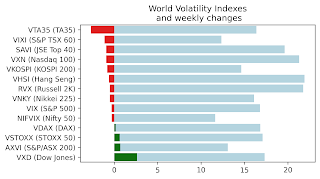
Wall st delivered a mixed bag of news with VIX, VNKY, and VSTOXX and their underlying markets almost unchanged. VXD - volatility index based...