VIX + Covid 19 Crisis = Opportunities

Anybody who’s been even remotely following the markets over the last month knows that we are living through exceptionally volatile times.

- VIX has reached an all time peak of 83, surpassing the 2008 highs


- Crude Oil VIX (OVX) has exceeded high of 220 vol ( 190 record close )


- VIX term structure went on a record inversion


- VXX has went up almost 400% in less than a month
and so on...

With this, a simple spread trade on VXX / VXZ made over 50% in the last month ( and at one point much higher )


And this extreme volatility is not about to subside - with virus still rapidly spreading and posing tremendous health hazards, peak unemployment claims announced just this morning, and increased risk of unhealthy inflation from QE Infinity, volatility is here to stay.

So how should we trade now that the "big move" has already happened? The risk / reward calculus is no longer obvious. Veteran VIX traders who have been through 2008 may have contrarian views, and consider the current regime to yield plenty more opportunities for great trades.

If you remember, in 2014 I interviewed John Hwang (ex head of VIX trading at MS) about how to trade the VIX during market crashes. Recently, I had a chance to speak to John again, and he’s confided that he’s out of retirement, trading up to 17 hours a day, and “arbing the heck” out of the curve.

So I begged him to share some of his favorite trade ideas, and how to navigate the VIX at these levels, after the vol spike… and suggested that he republish his classic book.

Well, republishing books takes a while and because trading opportunities can go away, John has agreed not only to talk about VIX again, but to do a live training webinar to discuss unique, once in a life time opportunities to capitalize in this high VIX regime both on short and long vol sides (yes, even at this level)!

The 2 hr webinar will happen this Sunday (March 29th) at 4 PM Eastern, with an exclusive Q&A session (seats limited), and I will be joining as well. If you are interested, check out this link to find out more.

Bitcoin In A Year - Analysis Of Reddit Predictions

Every year for the last 7 years user BlackSpidy runs a contest to predict bitcoin price year in advance. More than predicting, the forecasts reveal sentiment and general mood of the forum about bitcoin as I will demonstrate below. While the very first year of the contest started in December 2013 yielded too few predictions, 2014 and on had enough data to be parsed.

2014 was the year of Mt Gox failure, and rumors of bitcoin ban in China, and BTC crashed from 850 to 325, finishing the year around 378 . Reddit readers predicted a median price of 700 for the end of 2015.

2015 was a slow year for BTC, trading between 225 and 350, and finishing the year at 362 . The end of the year rally inspired readers to forecast the median price of 650.

2016 was a bullish year for BTC, when it doubled over year, finishing at 753 . Sentiment was highly positive and readers predicted 1270 for the next year.

2017 was obviously a gear year for bitcoin, when it grew 9x, finishing the year at 10,859 . Excitement about the possibilities was so high that median forecast for the next year was 51,000 and even 1st quintile of the forecasts was over 26,800 . Of course looking back these numbers were never realized, not even close.

2018 was a bearish year, with prices falling to the year end value of 4,165 . Reddit readers were predicting the doubling of the price since the lows for the year end of 8,350, which is not radically far from the 7,200 where we are about now.

Obviously 2019 was a good year for BTC, but the price still has not fully recovered. Oscillations around 10k level were quite wild, and in my opinion inspired more enthusiasm for the currency. Readers are predicting 2020 price of 17,110 , more than 2x of current price.

Given the positive bias of every annual prediction - that is redditors predict 2 times the current price, and about break-even realizations of the forecast, it is hard to make a concrete conclusion. Will bitcoin indeed stabilize above 10k next year, or will the market trade up and down around 10k level?

Whatever your opinion is, I suggest you check out Deribit exchange - currently the most liquid BTC and ETH options market. Merry Christmas and good luck with your trading!

Over the last few years I have been working more and more with NLP (natural language processing), a branch of AI focused on processing of text data, information extraction, figuring out relationships between different entities, etc. If you are interested in working on project processing your proprietary data into signals, or extracting information from public or government publications, send me an email.

Throw Away Your Skew Model : BTC at 10K


BTC is about to break into 10K territory - or already did on some exchange by the time I finish this post  - the level we have not seen in over a year. As we approach this round number we will observe the usual phenomenon of price clustering around this level, as key psychological level switches from support to resistance.

I typically do not pay significant attention to technical indicators, however this one is really different. Price clustering around key powers of 10 - like hundreds, thousands, or 10 thousands have been observed and well studied. While I do not know how will this impact spot returns, I can certainly say that it will have significant effect on the distribution of prices, and for option traders this means skew.

I expect skew behave quite different than it was before around this level, as trades will primarily focus on the price, as opposed to return / vol covariance, or other skew factors. If you're currently an options market maker - this will get tricky. And if you are a trader of options I expect there will be many interesting opportunities in the coming week or two.

If you're interested in trading BTC or ETH options there is only one exchange that I will recommend - Deribit


Bitcoin Put Skew

Quick note: after the sharp selloff last week market makers are repricing the downside risk in BTCUSD rate as traded on Deribit. Here are the skews for the first three months that I prepared.


The x axis is put delta, so it is in the same direction as strikes ( I do not know how to reverse axis so the numbers are declining from left to right )

There is a strong bidder for 2500 strike in Dec,  causing the spike in the last chart, but even without it we can see the elevated puts. On the other side, calls showing supply at this time, with largest sizes on the upside Dec calls.

In the meantime, someone on Twitter posted a painting by Ferdinand Hodler "Disillusioned One"


Volatility Crossover

Equity markets have been particularly volatile this month. Surprisingly, cryptocurrency markets have stagnated with low volatility and low volumes. BTCUSD was range-bound, with most of the last month trading in 6400-6500 range.

This morning tweeted this chart -


showing the crossover of volatilities. This is a strange time for markets; reminds me of 10 years ago, when I was talking with other traders about SPX/VIX crossover, that is is we would see SPY below VIX. These values did happen, although not at the same time ( SPY fell below 70, VIX rose above that about 2 months later ). My recommendation is to trade defensively in this market.

VIX Spot And Financial Innovation

Since CBOE launched VIX Index, it proved to be immensely popular measure of overall stock market risk. The popularity however was somewhat tempered - there is no way to trade VIX directly. Over the years there was some progress and financial innovation.

In 1993 Michael Webber, a trader from UBS structured a variance swap contract on FTSE index. Variance swap is a contract which payoff is proportional to volatility squared.  Variance swaps became a very popular OTC instrument, but it was not quite the same as volatility, and people wanted to trade volatility like they saw it on the news, or calculated on spreadsheets. Variance was easier to structure, but did not have quite the same appeal.

In early 2000s two Goldman Sachs quants - Sandy Rattray and Devesh Shah decided to tackle the problem. They updated and re-formulated VIX formula, and coordinated with CBOE to launch futures in 2004. Futures on VIX index grew in popularity overtime and became the dominant market for volatility price discovery. I have to add, that I am not sure if reformulation of formula was necessary - or even beneficial. VIX liquidity seem to have grown quite organically, first in futures, then in options, and most recently in ETFs and ETNs ties to VIX futures.

However majority of investors and stock traders did not have quite the easy access to VIX. In the US futures accounts and stock accounts regulated by separate government agencies, typically require different account opening documents, may or may not be cross-margined, basically there is some friction. VIX was prominent in the news during the 2008 financial crisis, and this provided an opportunity for Barclays to launch the first VIX ETF in 2009.

VXX overall was quite disappointing for traders looking to hedge stock market risk. I am not going to review VXX decay, as it has been explained adequately, just point out that for many people it did not work like VIX index, and it did not work like VIX futures, and it created a lot of frustration.

Since then there were two (major) attempts to bring something like VIX to the market. Building on liquidity of weekly SPX options CBOE introduced VXST Index - 9-day VIX, and launched futures and options in 2014. Unfortunately the instruments did not attract liquidity and disappeared by the end of the year (if I remember correctly)

More interesting product came from Accushares with VXUP and VXDN ETFs. I am linking here to an excellent explanation from Vance Harwood. The (half-baked, imo) idea was to make corrective distributions
 - dividend-like payments to bring NAV in line with the index, but since no reverse process existed, pricing pretty much fell completely out of line with the VIX, and the products were shortly delisted.

Now, I would like to bring attention to a different product in a different market - perpetual swaps on BTC, that afaik were first introduced at Bitmex, and now trade on Deribit and Cryptofacilities. Perpetual swap is actually a spot-like instrument, that pays "dividend" if swap midprice is below index, and requires "dividend payment" is swap midprice is above index. These payments insure that swap midprice does not stray far off the index.

Such instrument would be perfect for spot VIX instrument, however practically this seems impossible. Current financial regulation landscape makes it very difficult to introduce new instruments, and back-office infrastructure is mostly not equipped to handle two-directional payments.

The reason why crypto-exchanges succeeded with perpetual swaps is because their infrastructure was build from ground-up not 20 or 10 years ago, but within the last few years, without legacy requirements, on modern systems, with immediate trade and settlement capabilities. Traditional exchanges simply cannot do that. On the other hand, crypto-exchanges cannot trade VIX perpetual swap because the index trademark, calculations, and data dissemination belong to S&P or licensed to CBOE or CME, and they would not be interested in some other exchange taking over their very lucrative VIX franchise.

So, I believe that VIX spot instrument is at an impasse at this time. Maybe this will change in the future, and investors will have an instrument that will be directly tied to the VIX index value.


Max Pain - Two For Two

Ten days ago I wrote a post about max pain theory, and wrote down two ranges - first for immediate "weekly" expiration on Sep 21, and for the following expiration, Sep 28.
These ranges - 6500-6750 and 6500-7000 appear reasonable given recent market movement, but I would not read too much into them. We'll wait and see what the market actually does.  
Well, the results are in - when I made the prediction, on Sep 18th, the index was trading at around 6250 level, with both forecasts pointing (about 0.8 std) higher. Sep 21 futures settled at 6618.85, very close to middle of the forecast of 6625; Sep 28 futures settled at 6764.52, again very close to middle of the forecast of 6725.

I am intrigued with the results, and will keep monitoring the open interest on Deribit options.

Weekly market report

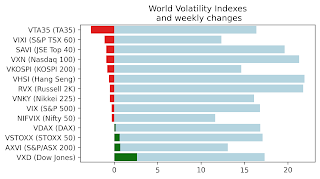
Wall st delivered a mixed bag of news with VIX, VNKY, and VSTOXX and their underlying markets almost unchanged. VXD - volatility index based...